Navigating the British education system as an adult can feel overwhelming. From the various Regulated Qualifications Framework levels to funding routes for level 2 courses free, there’s much to understand. This adult learner guide breaks down each of the seven stages of learning in England, explains the UK qualifications framework, highlights where government-funded opportunities sit, and offers practical advice to help you plan your educational journey.
Table of Contents
Overview of the British Education System for Adult Learners
Adult education in the UK spans a remarkably broad spectrum of learning opportunities from foundational literacy and numeracy, right through to doctoral‐level research and professional training. Although statutory schooling covers ages 5–16, adult learners typically re‐enter the system at Key Stage 4 or beyond, choosing from a wealth of government‐funded and fee‐paying courses tailored to their personal, vocational and professional goals. Below is a more detailed look at each stage, with guidance on how adult students can navigate them.
Early Years (0–5)
While not directly applicable to most adult learners, understanding the Early Years Foundation Stage can be useful for those pursuing careers in childcare, early years teaching or family support. Qualified professionals must achieve a minimum of a Level 2 or Level 3 qualification in Early Years Education, covering:
- Child development theory (physical, emotional, social)
- Safeguarding and welfare requirements
- Planning and delivering play–based learning activities
Primary Education (5–11)
Adult learners rarely revisit primary‐level study in a traditional sense; however, those who require literacy or numeracy support can access functional skills qualifications at Levels 1–2, equivalent in rigour to Key Stages 1–2. These courses focus on:
- Practical reading, writing and spoken communication
- Arithmetic (including budgeting and data interpretation)
- Problem‐solving in real‐world contexts
Such programmes are often free under government funding and available at local higher education institutions or through community‐based provision.
Secondary Education (11–16) / Level 2 Courses
Key Stages 3–4 culminate in GCSEs, but adult learners more commonly take:
- GCSE retakes in English and maths (fully funded for those without a grade 4/C).
- Functional Skills Level 2 qualifications (alternative route to demonstrate competency).
- Level 2 vocational certificates (e.g. BTEC Tech Awards, NVQs) in areas such as Customer Service, IT User Skills or Health & Social Care.
Funding note: Many Level 2 courses are fully subsidised by the Skills for Life or Lifetime Skills Guarantee programmes, making re‐qualification accessible at no cost.
Further Education (16+) / Level 3 & Apprenticeships
From age 16 onwards, learners can pursue:
- A‐levels in academic subjects (usually two‐year, classroom‐based).
- BTEC Nationals and Cambridge Technicals (vocational, equivalent to three A‐levels).
- Apprenticeships (employed learning with on-the-job training and day-release study).
Adult apprenticeships are available in dozens of occupational sectors and combine paid work with guided study; the government covers training costs for adults up to age 65 in many apprenticeship standards.
Higher Education (Level 4 and Above)
Universities and Higher Education (HE) Colleges offer:
- Higher National Certificates (HNC) and Higher National Diplomas (HND) for practical, career‐focused study.
- Undergraduate degrees (BA, BSc) typically lasting three years (or two years fast-track).
- Postgraduate qualifications (Master’s, PGCert/PGDip) and Doctorates (PhD) for advanced academic or professional specialisation.
Maintenance & Funding: Student loans and grants are available to UK residents; part‐time study routes may reduce overall debt.
Adult Learner & Community Learning (Stage 6)
Offered by FE colleges and community centres, these courses are designed for:
- Skills development (e.g. digital literacy, languages, creative arts).
- Personal enrichment (history, photography, fitness).
- Flexible delivery (evening classes, short workshops, online modules).
Often heavily subsidised or free for learners on low incomes, this sector emphasises small groups and learner‐centred teaching.
Continuing Professional Development (CPD)
Short, intensive modules keep professionals up to date in sectors such as:
- Education (Level 7 PGCE, SEND specialisms).
- Health & Social Care (safeguarding, clinical skills).
- Business & IT (project management, cyber security).
These courses may be employer-sponsored, paid for by professional bodies, or eligible for Adult Education Budget funding.
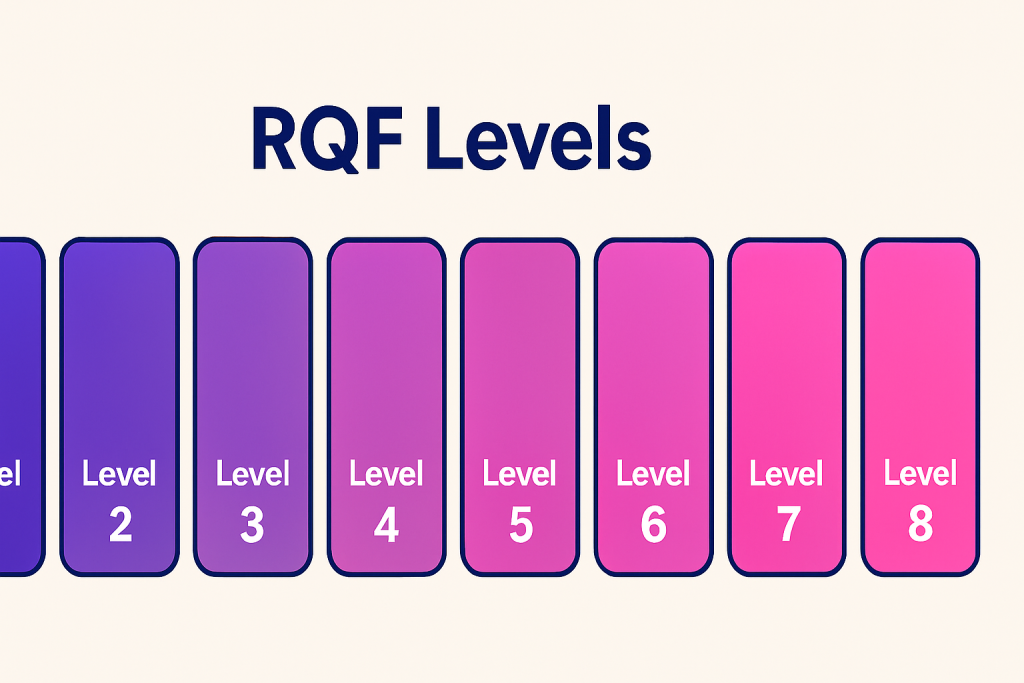
Understanding the UK Qualifications Framework: RQF Levels Of The British Education System Explained
The Regulated Qualifications Framework (RQF) organises UK qualifications by difficulty and complexity, guiding learners, employers and providers through clear progression routes. Below is an expanded guide to each level, key features, typical study formats, funding considerations and suggested next steps for adult learners.
Entry Level and Level 1 Qualifications
Entry Level (Pre-Level 1)
- Purpose: Build confidence in core skills before tackling formal qualifications.
- Content: Basic literacy (reading simple texts, writing short sentences), numeracy (counting, basic calculations) and introductory digital awareness (using a mouse, opening applications).
- Delivery: Often community-based or delivered online in bite-sized modules; typically 10–30 guided learning hours.
- Who it’s for: Absolute beginners, learners with English as an additional language or those re-entering education after a long break.
- Progression: Move on to Functional Skills Level 1 or GCSE resits once assessed as ready.
Level 1 (GCSE 3–1 Equivalent)
- Content:
- Functional Skills in English, Maths and IT, demonstrating practical application in everyday contexts (e.g. writing emails, budgeting).
- Vocational Certificates (e.g. Customer Service, Food Hygiene, Employability Skills).
- Study load: 90–180 guided learning hours; classroom, blended or fully online formats.
- Assessment: Combination of assignments, practical tasks and on-screen tests.
- Funding:
- Many Level 1 courses are free under the Adult Education Budget (AEB) if you lack a higher qualification.
- Concessionary places for unemployed or low-income learners.
- Next steps: Progress to Functional Skills Level 2, GCSE resits or Specialist Level 2 vocational programmes.
Level 2 and Level 3 Qualifications
Level 2 (GCSE 4–9 Equivalent)
- Typical qualifications:
- GCSEs in English and Maths (resits).
- Functional Skills Level 2 (alternative to GCSEs).
- Vocational Diplomas (e.g. BTEC Tech Award in IT User Skills, NVQ in Health & Social Care).
- Benefits: Recognised by employers and many higher-level courses as a minimum standard.
- Study formats: Full-time (six months), part-time evening/weekend, or online distance learning.
- Funding:
- Fully funded under the Lifetime Skills Guarantee for adults without a Level 3.
- Loans available if self-funding.
- Progression:
- Into Level 3 study (A-levels, Advanced Diplomas).
- Entry to intermediate apprenticeships (Level 2).
- Employment in roles requiring GCSE-level competence.
Level 3 (A-Level and Advanced Diplomas)
- Typical qualifications:
- A-levels (academic subjects, 360 guided learning hours each).
- BTEC Nationals, Cambridge Technicals (vocational, equivalent to three A-levels).
- Advanced Apprenticeships (on-the-job training plus off-the-job study).
- Assessment: Exams (A-levels), coursework, practical assessments (BTECs).
- Funding:
- Government covers tuition fees for most Level 3 programmes up to age 23.
- Concessionary or fee-waiver options for mature learners on low incomes.
- Next steps:
- Level 4 study (HNC, HND), Degree programmes.
- Skilled employment or higher apprenticeships.
Level 4–8 Qualifications: Higher Education and Beyond
Level 4–5 (HNC, HND and Professional Diplomas)
- Level 4 (HNC)
- Equivalent to the first year of a bachelor’s degree.
- Focus on practical, vocational skills e.g. Engineering, Business Studies, Health & Social Care.
- Typical duration: 1 year full-time or 2 years part-time.
- Level 5 (HND, DipHE)
- Builds on HNC, equivalent to the second year of undergraduate study.
- Often includes workplace projects or placements.
- Delivery & assessment:
- College-based lectures, workshops, assessed projects and sometimes employer-set tasks.
- Funding & finance:
- Tuition fee loans via Student Finance England/Scotland/Wales.
- Employer sponsorship or professional body grants may apply.
- Progression:
- Top-up Degree (Level 6).
- Specialist professional qualifications or direct entry into managerial roles.
Level 6–8 (Bachelor’s to Doctorate)
- Level 6 (Bachelor’s Degree)
- Three- or four-year programmes; honours classification (e.g. BA (Hons), BSc (Hons)).
- Includes dissertations, independent research and placement years.
- Level 7 (Master’s, PGDip/PGCert)
- One-year full-time or two-year part-time; research master’s can extend longer.
- Mix of lectures, seminars and independent study.
- Level 8 (Doctorate/PhD)
- Original research culminating in a thesis; typically three to four years.
- Funding considerations:
- Undergraduate and postgraduate loans available; eligibility varies.
- Scholarships, fellowships and institutional bursaries for research students.
- Outcomes:
- Professional accreditation (e.g. Chartered status).
- Academic or specialist career pathways.

Navigating Your Pathway As An Adult Learner In The British Education System
- Factor in time-investment, entry requirements and assessment styles.
Assess your starting point
- Use free, online self-assessment tools (e.g. Functional Skills diagnostics).
- Speak to an FE college adviser or National Careers Service.
Explore delivery modes
- In-person: Structured support, peer networking.
- Online/blended: Flexibility for working adults, but requires self-discipline.
Check funding eligibility
- Adult Education Budget, Lifetime Skills Guarantee and Advanced Learner Loans.
- Employer-sponsored training and apprenticeships.
Set clear goals
- Short-term (e.g. functional skills, a vocational certificate).
- Long-term (e.g. degree, professional chartership).
Plan for progression
- Map out which RQF levels you need to reach your desired role.
Government-Funded Support within the British Education System
Multiple streams help adult learners afford study:
Adult Learners and Government-funded Level 2 Courses
The Adult Education Budget fully funds eligible learners aged 19+ on level 2 courses delivered by higher education institutions and approved organisations.
Discretionary Learner Support Funds
Covers childcare, travel and equipment costs for learners on free course government funded programmes apply via your provider’s student services.
Advanced Learner Loans and Other Support
- Advanced Learner Loans (Level 3+): Repayable loans with favourable terms for those planning higher-level study.
- Professional & Career Development Loans: Low-interest bank loans for workplace learning.
- University Scholarships & Grants: Merit- or need-based support for degree-level study.
Practical Tips for Adult Learners in the British Education System
Assess Your Goals and Current Level
Map your existing qualifications against the Regulated qualifications framework to identify the next RQF level and look for courses that align with your career objectives.
Here are some of our accredited Level 2 Courses.

Level 2 Certificate in Digital Marketing

Certificate in the Principles of Cybersecurity
Select the Right Qualification
Verify course accreditation, format and learner support. Ensure the provider appears on the ESFA’s funded-courses catalogue to guarantee free government funded course status.
Checking Accreditation and Regulation
Look for reputable awarding bodies (e.g. TQUK, CACHE, NCFE, Pearson) to confirm your certificate is nationally recognised.
Armed with this comprehensive adult learner guide, which is a clear map of the British education system, and understanding of the UK qualifications framework, you can confidently plan your next steps. Whether that’s level 2 courses qualification, an Access to Higher Education diploma or beyond.
Disclaimer
The information here is intended as general guidance only. My Free Course cannot be held responsible for any choices you make after reading this blog.
If you need more details or have questions, please email us at [email protected].
FAQs
What is the difference between Further Education, Higher Education and adult & community learning?
Further Education delivers post-16 vocational and academic programmes; Higher Education provides degree-level study; adult & community learning offers part-time, non-accredited courses.
How do I know which RQF level to target?
Align your career or academic goals with RQF descriptors: Level 2 for GCSE-equivalent skills, Level 3 for A-level standard, Levels 4+ for higher education.
Can I take a Level 2 course free if I already have GCSEs?
Yes, provided your existing GCSEs are in different subjects. Repeat funding for the same qualification is restricted.
Are apprenticeships part of the adult education system UK?
Yes. Apprenticeships span RQF Levels 2–7, combining paid employment with funded training.
What funding is available for Level 3 or above?
Advanced Learner Loans and learner co-contributions apply, though Universal Credit recipients and low-income learners often have fees waived.
Where can I find a complete list of funded courses?
Go to our website to discover free courses online with certificate options.