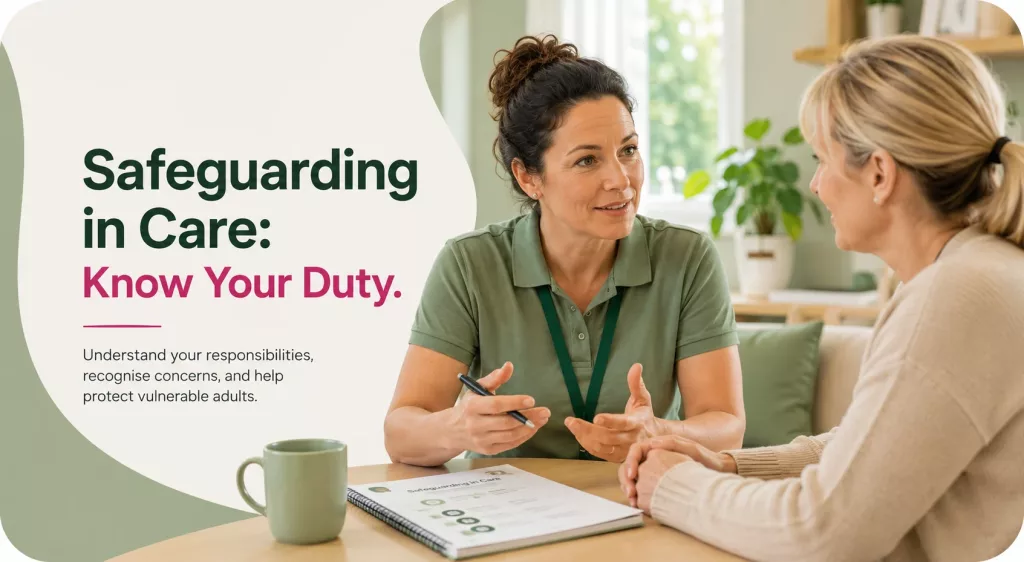
Safeguarding is one of the most frequently used words in health and social care. It is also one of the most inconsistently understood.
Many care workers can define it in broad terms. Far fewer can name the ten categories of abuse under the Care Act 2014, describe the correct reporting pathway, or explain where their individual duty ends and their organisation’s duty begins. That gap is not a minor knowledge shortfall. In safeguarding, it is the gap where harm happens.
According to Skills for Care’s 2024 Workforce Intelligence Report, approximately 39 percent of the adult social care workforce has completed formal safeguarding training. That means a significant proportion of frontline workers may still be unclear about their exact duties when a concern arises.
Safeguarding in care is a legal duty, not a management responsibility passed down when something goes wrong. It belongs to every person who works with adults or children at risk, from the first day in a care role to the most senior level.
This article explains what safeguarding in care means, who is responsible, what abuse looks like, how to report correctly, and why accredited training makes a practical difference in real situations.
Quick Answer
What is safeguarding in care? It means protecting adults and children who are at risk of abuse, neglect, or harm. In the UK, safeguarding is both a legal duty and a professional responsibility for everyone working in health and social care. It covers everything from recognising warning signs to reporting concerns through the correct channels. Knowing what safeguards in care are not optional. It is the foundation of safe, ethical practice.
Table of Contents
What Is Safeguarding in Care?
Understanding what is safeguarding in care starts with a simple definition. Safeguarding means protecting people’s health, well-being, and right to live free from abuse, neglect, and exploitation.
In care settings, safeguarding runs through every interaction. It shapes how you observe, how you communicate, and how you respond when something does not feel right.
The goal of safeguarding in care is not only to respond to harm after it occurs. It is to prevent harm in the first place by creating environments where people feel safe, heard, and treated with dignity.

Safeguarding Adults
Adult safeguarding applies to anyone aged 18 or over who has care and support needs and is at risk of abuse or neglect.
The Care Act 2014 places a legal duty on local authorities in England to make safeguarding enquiries when they believe an adult at risk may be experiencing harm. Care providers and their staff share a direct responsibility for identifying and reporting concerns.
What is safeguarding in care for adults? It means acting on any concern, no matter how small it seems. A small observation reported early can prevent serious harm later.
Safeguarding Children
Child safeguarding applies to any person under the age of 18. It covers abuse, neglect, exploitation, and any act or omission by an adult that causes harm or places a child at risk of harm.
Many care workers who support adults also come into contact with children, such as family members visiting or young carers in the home. Knowing what is safeguarding in care apply equally in those situations.
Who Is Responsible for Safeguarding in Care?
Safeguarding in care is everyone’s responsibility. It does not belong only to managers, safeguarding leads, or HR departments.
Individual Responsibility
Every person working with adults or children at risk has a personal duty to act if they have concerns. This includes care assistants, support workers, healthcare assistants, and anyone providing care in any setting.
You do not need proof of abuse before you raise a concern. You need reasonable concern. The threshold for reporting is deliberately low because early intervention saves lives and prevents escalation.
Staying alert, trusting your insticts, and knowing exactly what to do nextare what safeguarding looks like at an individual level.
Organisational Responsibility
Employers and care providers have a legal duty to have a safeguarding policy in place. They must ensure staff receive appropriate training, know who the designated safeguarding lead is, and understand the referral pathway.
CQC inspections assess whether safeguarding systems are effective and whether staff can demonstrate their knowledge. Failing on safeguarding grounds carries serious consequences, including enforcement action, reputational damage, and in some cases, closure.
What Are the Types of Abuse in Safeguarding?
The Care Act 2014 identifies ten categories of abuse in adult safeguarding:
- Physical abuse
- Emotional or psychological abuse
- Financial or material abuse
- Sexual abuse
- Neglect and acts of omission
- Discriminatory abuse
- Institutional or organisational abuse
- Self-neglect
- Domestic violence and abuse
- Modern slavery
Each category presents different warning signs and requires a different response. Being able to identify all ten is a core part of what safeguarding knowledge looks like in practice.
Financial abuse is often invisible in its early stages. An older adult who suddenly lacks money for essentials, or who is being pressured to change a will, may be experiencing financial abuse. Knowing this matters when you are the person in closest contact.
Institutional abuse occurs when poor care practices become normalised within a setting. This is why safeguarding must be embedded at an organisational level, not addressed only in individual training sessions.
What Are the Signs of Abuse or Neglect?
Knowing what is safeguarding in care includes knowing what harm actually looks like. Signs of abuse and neglect are not always obvious. They are often subtle, gradual, and easy to explain away.
Physical Signs
Physical signs of abuse may include unexplained bruising, burns, cuts, or injuries that do not match the explanation given. Repeated or clustered injuries in unusual places are also a concern.
Signs of neglect can include poor personal hygiene, significant weight loss, untreated medical conditions, or pressure sores that suggest inadequate repositioning care. Deteriorating physical health that has no clear medical explanation is always worth noting and reporting.
Behavioural and Emotional Signs
Behavioural signs may include sudden withdrawal, increased anxiety, fearfulness around specific people, or distress that seems disproportionate to what is happening.
A person who becomes unusually quiet, avoids eye contact, or reacts badly to physical contact may be trying to communicate something they cannot say directly. Safeguarding in care means reading these signals and acting on them.
Changes in behaviour following a specific person’s visit, or a refusal to be alone with a particular carer, are always significant. Document what you observe and report it without delay.
Environmental Signs
Environmental signs include a person living in unsafe, cold, or unhygienic conditions. An absence of food in the home, inadequate heating, or missing medication may point to neglect.
In residential settings, poor documentation, unexplained changes in a person’s care records, or missing personal items can also be indicators. What is safeguarding in care requires you to look beyond the individual and consider their full environment.
What Should You Do If You Have a Concern?
If you have a concern, you must act on it. Doing nothing is not a neutral choice in safeguarding. It carries real risk for the person you are there to protect, and personal and professional risk for you.
The Duty to Report
In England, care workers have a professional and organisational duty to report safeguarding concerns to their designated safeguarding lead. Most employers have a safeguarding policy that sets out the exact steps.
You should know where that policy is kept and who your safeguarding lead is before you need to use that knowledge in an urgent situation. If you do not know this, ask today.
You do not need to investigate the concern yourself. Your role is to observe, record, and report. Investigating is the responsibility of those with the authority and training to do so.
How to Document a Concern
Write down exactly what you saw, heard, or were told. Use the person’s own words if they made a disclosure. Record the date, time, and location.
Do not add your interpretation or opinion. Write only what you directly observed. This keeps the record factual and protects both the person at risk and you as the reporting worker.
Complete the documentation as soon as possible after the event. Memory fades quickly, and accurate records are essential if the concern progresses to a formal enquiry.
What Happens After You Report?
Once a concern is reported internally, your organisation’s safeguarding lead assesses it and decides whether to make a referral to the local authority’s adult or children’s social care team.
In England, local authority safeguarding teams are required under the Care Act 2014 to respond to referrals and determine whether a formal safeguarding enquiry under Section 42 is needed.
Your role as the person who raised the concern is to cooperate with any subsequent investigation and to continue observing and recording any further developments.
Safeguarding and the Law in England
A working knowledge of the legal framework underpins everything else. This matters for care workers and for employers who must demonstrate compliance.
- The Care Act 2014 is the primary legislation governing adult safeguarding in England. It established Safeguarding Adults Boards in every local authority area and placed a statutory duty on councils, NHS bodies, and the police to cooperate in protecting adults at risk.
- The Mental Capacity Act 2005 protects the rights of people who may lack capacity to make decisions about their own care, welfare, or finances. Every person is assumed to have capacity unless assessed otherwise. Decisions must always be made in the person’s best interests when they lack capacity. This shapes how care workers must act when they suspect abuse involving someone who cannot report it themselves.
- The Children Act 1989 and its 2004 amendment, supported by Working Together to Safeguard Children 2023, set out how organisations and individuals must cooperate to keep children safe. If you work with adults who have children at home, or with young carers, these frameworks apply to your practice too.
Knowing the principles of safeguarding in theory is important. A nationally recognised qualification that demonstrates and develops that knowledge is what makes the difference in practice, in inspections, and in career progression.
Safeguarding training gives care workers the language and structure for situations that can feel overwhelming in the moment. It removes the uncertainty of wondering whether you are responding correctly.
It also protects you. A care worker who has completed accredited training and followed the correct reporting pathway is in a far stronger position if a situation is ever reviewed or investigated.
For employers, a workforce with current accredited safeguarding training directly supports a positive CQC outcome. The cost of non-compliance far exceeds any admin fee associated with funded training.
This course covers the legal framework, types of abuse, duty of care, and how to respond correctly to concerns. It is fully online, self-paced, and assessed through coursework rather than formal exams. Tuition is funded through the Adult Skills Fund for eligible learners.
Frequently Asked Questions
What is safeguarding in care, in simple terms?
Safeguarding in care means protecting adults and children at risk from abuse, neglect, and harm. It is a legal and professional duty for everyone working in health and social care, not just managers or senior staff.
Who is responsible for safeguarding in care settings?
Safeguarding is everyone’s responsibility. Every care worker, support worker, or healthcare assistant who works with people at risk has a duty to act on concerns. Employers must have policies, training, and designated safeguarding leads in place.
What are the ten types of abuse in adult safeguarding?
Under the Care Act 2014, the ten types are: physical, emotional or psychological, financial or material, sexual, neglect, discriminatory, institutional or organisational, self-neglect, domestic violence, and modern slavery.
Do I have to report a safeguarding concern even if I am not certain?
Yes. You do not need proof of abuse to raise a concern. Reasonable concern is enough. The threshold for reporting in safeguarding in care is intentionally low. Report what you have observed and let the designated safeguarding lead assess it.
What happens if a care worker does not report a safeguarding concern?
Failure to report can result in disciplinary action, referral to the Disclosure and Barring Service, or referral to a professional regulatory body in serious cases. It can also put the person at risk of continued harm.
Is there funded training available on what safeguarding in care is?
Yes. The Level 2 Certificate in Understanding Dignity and Safeguarding in Adult Health and Social Care is available through the Adult Skills Fund for eligible learners. Tuition is fully funded. Some partner colleges charge an admin fee of £50 to £100.
How does safeguarding training affect CQC inspections?
CQC assessors review safeguarding policies, training records, and staff knowledge during inspections. Accredited safeguarding training directly supports a positive CQC outcome and demonstrates that your organisation takes its legal duties seriously.
Disclaimer
Tuition fees for eligible learners are fully funded by the Adult Skills Fund. Some partner colleges may charge an administration fee (typically £50-£100) for registration and certification, but not us. At My Free Course, it’s completely free.
This varies by provider. Eligibility depends on individual circumstances, including age, residency, earnings, and prior qualifications. My Free Course acts as an intermediary between learners and partner colleges. Course availability is subject to change. Geographic exclusions apply. This content is for informational purposes only and does not constitute legal or professional advice. Visit MyFreeCourse.co.uk for the most current course and eligibility information.