
Safeguarding is covered in almost every care induction. It is referenced in every CQC inspection. It appears in job descriptions, policy documents, and supervision notes throughout the sector.
And yet, when something goes wrong, the most common finding is the same. Someone saw something. They were not sure what to do. They did not act.
That gap between awareness and action where harm happens.
Why safeguarding is important is not a question most care workers struggle to answer in broad terms. They know it matters. What is less clear, without structured training and explicit frameworks, the specific concern that does not quite feel serious enough to report but does not quite feel right either.
NHS Digital’s 2023/24 data recorded over 164,000 concluded adult safeguarding enquiries in England in a single year. That figure covers only concerns that were reported and progressed. It does not include thosethat were noticed, felt uncertain about, and left unreported.
Safeguarding is important not only when cries happen. It is important in every interaction, on every shift, across every setting. This article explains why, with reference to data, legal duty and the real consequences of getting it wrong in either direction.
Quick Answer: Why Is Safeguarding Important in Health and Social Care?
Why is safeguarding important? Because the people who need care are among the most vulnerable in society, and without strong safeguarding systems, they face a significantly higher risk of abuse, neglect, and lasting harm. In England, over 176,000 adult safeguarding enquiries were commenced in a single year. Safeguarding is a legal requirement, a professional duty, and the foundation of genuinely person-centred care. It matters not only when crises happen, but in every interaction of every shift.
Table of Contents
The Scale of the Problem: Safeguarding Data in the UK
Why is safeguarding important? The data answers that question more clearly than any definition can.
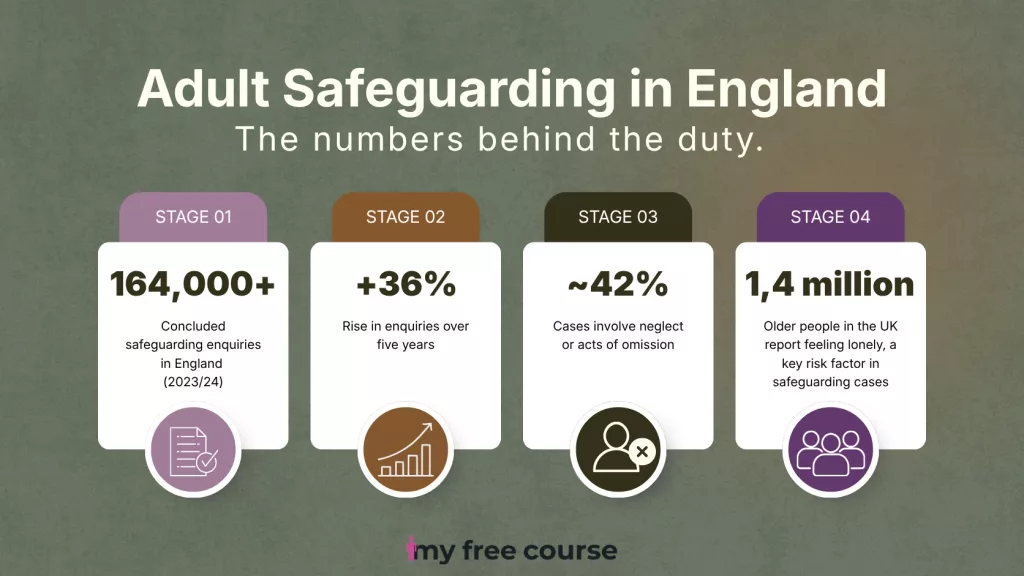
NHS Digital’s Adult Social Care Safeguarding data for 2023/24 recorded more than 164,000 concluded safeguarding enquiries in England. That figure has risen by approximately 36 percent over the five years to 2023/2024, reflecting both a growing care population and improved reporting by trained care workers.
Neglect and acts of omission were the most common of harm identified, accounting for approximately 42 percent of all concluded enquiries. Physical abuse was the secondd most common category, followed by financial or material abuse. Age UK estimates that financial abuse of older people costs victims in England over £1 billion annually, much of it going undetected for extended periods.
Adults with mental health conditions, dementia, and learning disabilities are significantly overpressed in safeguarding enquiries relative to their share of the care population. People with limited or no verbal communication are at particular risk becauethey may be unable to report concerns themselves. Social isolation amplifies that risk further. Approximately 1,4 million older people in the UK report feeling lonely, and isolation consistently appears as a background factor in safeguarding cases.
These are not rare events in exceptional settings. They are the everyday backdrop of adult social care in England.
What Happens When Safeguarding Fails?
Understanding why safeguarding is important means being honest about what failure looks like. Not just in policy terms, but in human terms.
Safeguarding failures are not abstract regulatory events. They are situations where a real person experienced harm that could have been prevented.
- The Human Cost: When safeguarding fails, the consequences for the individual can be severe and lasting. Physical injury, psychological trauma, financial loss, loss of independence, and, in the most serious cases, death. Studies cited in NHS England’s safeguarding literature consistently show that survivors of care-setting abuse experience elevated rates of depression, anxiety, and post-traumatic stress. The psychological impact is compounded by the fact that the setting was supposed to be a place of safety.
- The organisational cost: According to the CQC’s State of Care 2023/24 report, safeguarding failures are among the most common reasons for services being rated Inadequate or Requires Improvement. A service rated Inadequate faces enforcement action, restrictions on admissions, increased monitoring, and, in the most serious cases, closure. Local authority contracts can be terminated. Insurance requirements can be triggered. The cost of non-compliance in safeguarding is almost always higher than the cost of training and prevention.
- The Personal Cost to Care Workers: Care workers who do not act on a safeguarding concern face disciplinary action from their employer, referral to the Disclosure and Barring Service, or referral to a professional regulatory body. In cases of wilful neglect under the Care Act 2014, criminal prosecution is also possible. Beyond formal consequences, many care workers involved in safeguarding failures report lasting impact on their confidence and wellbeing. Safeguarding knowledge protects the person receiving care and the care worker in equal measure.
Why Safeguarding Is Important Beyond Crisis Response
One of the most common misunderstandings about safeguarding is that it is only relevant in a crisis. Why is safeguarding important on a quiet, uneventful Tuesday morning? The answer matters.
Most safeguarding practice does not happen in a crisis. It happens through the cumulative effect of thousands of small, consistent, respectful interactions over days, weeks, and years.
Every time a care worker knocks before entering a room, they are practising safeguarding. Every time they confirm that a person has understood and agreed to a decision about their care, they are practising safeguarding. Every time they notice something slightly different about a person’s mood or behaviour and record it accurately, they are practising safeguarding.
The absence of these acts is precisely how neglect and institutional abuse develop. Quietly. Gradually. Without a dramatic incident.
Dignity is central to this. The right to dignity is one of the founding principles of the Care Act 2014. Treating someone respectfully, involving them in decision, and upholding their independence are all safeguarding acts. When dignity is consistently absent, the conditions for more serious harm become more likely.
People who receive care are often in a position of significant dependency. They may rely on others for personal care, medication, finances, and daily decisions. That dependency create a power imbalance that, without robust safeguarding practice, can be exploited. Safeguarding is how that responsibility is structured and sustained/
The Legal Case: Why Safeguarding Is Non-Negotiable
Safeguarding in England is not discretionary. It is underpinned by legislation that places clear duties on organisations, local authorities, and individual professionals.
- Making safeguarding personal, introduced by the Care Act 2014, requires that safeguarding responses focus on the outcomes the individual themselves wants, not just on what the system determines is safest. This shift safeguards from something done to a person toward something done with them. Services that embed this approach report significantly higher satisfaction from the people they support during the safeguarding process.
- CQC inspection, The Care Quality Commission assesses safeguarding under the Safe key question. Inspectors assess whether staff understand their responsibilities, whether systems are in place to identify and respond to concerns, and whether the provider has created a genuine culture of safeguarding. Services that cannot demonstrate this, through documentation, staff knowledge, and leadership behaviours, face the most serious regulatory consequences.
Why Safeguarding Knowledge Protects Care Workers Too
This dimension of safeguarding importance is often overlooked.
When a care worker understands what to look for, how to document it accurately, and who to report it to, they are protected. They are protected from the anxiety of witnessing something concerning and not knowing what to do. They are protected from professional consequences of inaction. They are protected from situations where poor practice by colleagues puts them in a legally or professionally ambiguous position.
Skills for Care’s 2024 workforce data shows that care workers who report high confidence in their safeguarding knowledge are significantly more likely to raise concerns promptly and less likely to experience burnout related to moral distress.
Formal, accredited training is the most reliable way to build that confidence. It replaces uncertainty with a clear framework.
What a Strong Safeguarding Culture Looks Like
Individual training is not enough on its own. Safeguarding must be embedded in the culture of a care setting to be effective.
A strong safeguarding culture is one where concerns can be raised without fear of reprisal. Where poor practice is challenged rather than normalised. Where the people receiving care are actively encouraged to speak up and their voices are taken seriously when they do.
The CQC’s 2023/24 thematic review of safeguarding in adult social care found that services which perform best on safeguarding outcomes share consistent cultural markers: transparent communication between staff and leadership, regular safeguarding discussions in team meetings, and a clear visible commitment from managers to act on concerns quickly.
For care home owners and HR managers, building this culture begins with ensuring every member of the team understands not just the procedures, but why safeguarding is important in the first place.
Building Your Safeguarding Confidence Through Training
Knowledge is the difference between uncertainty and confident, safe practice.
Two courses directly address the knowledge and confidence needed to make safeguarding part of everyday practice.
- Level 2 Certificate in Understanding Dignity and Safeguarding in Adult Health and Social Care: Covers the full legal framework, duty of care, protecting dignity in every interaction, and how to respond when concerns arise. Designed for care workers who want to understand not just what to do, but why it matters. Fully online, self-paced, coursework-assessed.
- Level 2 Understanding Safeguarding and Prevent: Extends safeguarding knowledge to cover the Prevent duty, radicalisation, and online safety alongside core adult safeguarding principles. It is particularly relevant for care workers operating in community settings, supported living, and any role with contact with children or young people. Fully online, self-paced, coursework-assessed.
Both courses are funded through the Adult Skills Fund for eligible learners. Tuition is covered in full. Some partner colleges may charge an admin fee of £50 to £100.
Frequently Asked Questions (FAQ)
Why is safeguarding important for care workers personally, not just for their employers?
Care workers who understand and follow safeguarding procedures are protected professionally. They know how to document concerns accurately, who to report to, and what to expect from the process. Workers without that knowledge risk inaction, which can result in disciplinary action, DBS referral, or in serious cases, criminal proceedings under the Care Act 2014.
How many safeguarding cases happen in England each year?
NHS Digital’s 2023/24 data recorded over 164,000 concluded adult safeguarding enquiries in England in a single year. This figure has risen by approximately 36% over the five years to 2023/24, reflecting both a growing care population and improved recognition and reporting.
Is safeguarding the same as the duty of care?
They are related but distinct. Duty of care is a legal obligation to take reasonable steps to avoid causing harm. Safeguarding is the broader framework designed specifically to protect vulnerable people from abuse and neglect. Safeguarding sits within the duty of care but is more specific in its scope, procedures, and legal basis.
Why is safeguarding important in the context of dignity?
Dignity is a legal right under the Care Act 2014. Consistently treating people with respect, involving them in decisions, and upholding their independence are all safeguarding acts. When dignity is routinely absent, the conditions for more serious harm become more likely. Safeguarding and dignity are not separate concerns.
Can safeguarding failures lead to criminal prosecution?
Yes. The Care Act 2014 introduced an offence of wilful neglect and ill-treatment of adults who lack capacity. Individual care workers and providers can face criminal prosecution where neglect or ill-treatment is proven. This is separate from and in addition to regulatory and disciplinary consequences.
Is there funded training available on why safeguarding matters in practice?
Yes. The Level 2 Certificate in Understanding Dignity and Safeguarding in Adult Health and Social Care and the Level 2 Understanding Safeguarding and Prevent are both funded through the Adult Skills Fund for eligible learners. Tuition is fully covered. Some partner colleges charge an admin fee of £50 to £100.
Disclaimer
Tuition fees for eligible learners are fully funded by the Adult Skills Fund. Some partner colleges may charge an administration fee (typically £50-£100) for registration and certification, but not us. At My Free Course, it’s completely free.
This varies by provider. Eligibility depends on individual circumstances, including age, residency, earnings, and prior qualifications. My Free Course acts as an intermediary between learners and partner colleges. Course availability is subject to change. Geographic exclusions apply. This content is for informational purposes only and does not constitute legal or professional advice. Visit MyFreeCourse.co.uk for the most current course and eligibility information.