
You notice the shift before anyone else does.
The sudden outbursts. The refusal to get dressed. The meltdown over something that seems small. The silence that replaces conversation. The school phone calls that start with “We just wanted to make you aware…”
You are not looking for labels. You are not looking for blame. You just want to understand your child.
When behaviour feels intense, unpredictable or misunderstood by others, it can leave parents feeling isolated and unsure. Is this a phase? Is it something deeper? Am I handling this the right way? Why does traditional discipline make it worse?
For many families, the real frustration is not the behaviour itself. It is the lack of clear explanation. Behaviour is often treated as something to control rather than something to understand.
Understanding behaviour that challenges in children begins with one powerful shift. Behaviour is communication.
Table of Contents
Quick Answer: What Does Understanding Behaviour That Challenges Mean?
Understanding behaviour that challenges means recognising that difficult or distressed behaviour is often a form of communication. Instead of viewing it as deliberate disobedience, it involves identifying underlying emotional, sensory, developmental or environmental causes and responding in ways that support regulation, safety and learning.
What This Means For You
This applies to you if:
- You are aged 19 or over
- You live in England
- You want evidence based, structured knowledge rather than opinion
- You are trying to make sense of repeated behavioural difficulties
- You are considering accredited study in understanding behaviour that challenges
This may not apply if:
- You live outside England
- You are under 19
- You are looking only for informal parenting tips rather than recognised qualifications
Why it matters:
- Behaviour that challenges can affect school relationships, family stability and emotional wellbeing
- Misinterpretation can escalate distress
- Structured knowledge improves parental confidence
- Accredited learning is valued across education, care and support sectors
Where applicable, funding is generally available for eligible adults earning under £25,750, subject to postcode and Adult Skills Fund rules.
Understanding Behaviour That Challenges as Communication
Understanding behaviour that challenges requires a shift in perspective.
Children do not wake up planning to be difficult. When behaviour escalates, it often reflects:
- Overwhelm
- Anxiety
- Sensory overload
- Communication barriers
- Trauma history
- Neurodevelopmental differences
- Frustration
- Lack of regulation skills
The Department for Education and NICE guidance emphasise early identification of underlying needs rather than punitive response.
Behaviour that challenges can include:
- Aggression
- Withdrawal
- Repetitive behaviours
- Refusal
- Emotional outbursts
- Self injurious behaviour
Each of these behaviours can represent an unmet need.
Understanding behaviour that challenges means asking:
- What happened before this behaviour?
- What skill might be missing?
- What is the child trying to communicate?
- Is the environment contributing?
This approach aligns with trauma informed practice and positive behaviour support frameworks widely used across UK education and care settings.
The Science Behind Behaviour That Challenges
Understanding behaviour that challenges involves developmental neuroscience.
The prefrontal cortex, responsible for impulse control and reasoning, continues developing throughout childhood and adolescence. The amygdala, responsible for emotional response, reacts rapidly to perceived threat or stress.
When a child appears defiant, the brain may be in fight, flight or freeze mode.
Chronic stress can impact:
- Emotional regulation
- Attention
- Memory
- Executive function
Research referenced by Public Health England and NHS England highlights how early adversity influences behavioural responses.
Understanding behaviour that challenges therefore includes:
- Attachment theory
- Stress response systems
- Sensory processing differences
- Emotional literacy development
This is not about excusing behaviour. It is about understanding the mechanism driving it.
Emotional Regulation and the Developing Brain
Children are not born knowing how to regulate emotions. Regulation is co-created.
When adults model calm responses, label emotions and provide predictable structure, children gradually internalise those skills.
Understanding behaviour that challenges requires recognising:
- Regulation precedes reasoning
- A dysregulated child cannot process instruction
- Shame escalates distress
- Predictability reduces anxiety
This is particularly important for neurodivergent children, including those with autism, ADHD or sensory processing differences.
Understanding behaviour that challenges in neurodivergent children often includes recognising:
- Sensory triggers
- Literal interpretation of language
- Executive functioning challenges
- Difficulty with transitions
Ofqual regulated qualifications in understanding behaviour that challenges provide structured modules exploring these factors in detail.

Triggers, Patterns and Environmental Factors
Behaviour does not occur in isolation.
Understanding behaviour that challenges includes identifying patterns such as:
- Time of day
- Specific environments
- Particular individuals
- Transitions
- Academic pressure
- Social situations
Recording behaviour patterns can reveal triggers.
For example:
- Sensory overload in noisy classrooms
- Hunger or fatigue
- Unclear instructions
- Unexpected changes
- Peer conflict
Understanding behaviour that challenges involves analysing context before consequence.
Schools increasingly use positive behaviour support plans rooted in evidence based frameworks supported by the Education Endowment Foundation.
Parents who understand these frameworks are better positioned to collaborate constructively with schools.
The Role of Schools and Wider Systems
Schools operate under statutory safeguarding duties and behaviour policies. Approaches vary.
Understanding behaviour that challenges enables parents to:
- Engage in structured conversations
- Reference recognised frameworks
- Understand SEND pathways
- Recognise when assessment may be appropriate
The SEND Code of Practice emphasises early support and graduated response.
An informed parent can advocate effectively without escalating conflict.
The Mechanism Explained: How Government Funded Learning Supports Parents
Structured qualifications in understanding behaviour that challenges are funded through the Adult Skills Fund.
The funding flow operates as follows:
Government → Adult Skills Fund → Accredited College → My Free Course → Learner
The UK Government allocates funding to accredited colleges to deliver qualifications in areas where there are national skills gaps, including child development, education support and behavioural understanding.
Colleges are regulated by Ofqual and often work with awarding bodies such as NCFE or TQUK.
My Free Course connects eligible adults in England with colleges funded to deliver these qualifications.
Why funding exists:
- To close national skills shortages
- To improve workforce competence
- To strengthen safeguarding and inclusion standards
Why commitment matters:
Public funding covers tuition costs. Learners are expected to complete coursework and engage fully so that public investment results in recognised qualifications and measurable skills.
Don’t assume you’re ineligible My Free Course walks you through the process step by step.
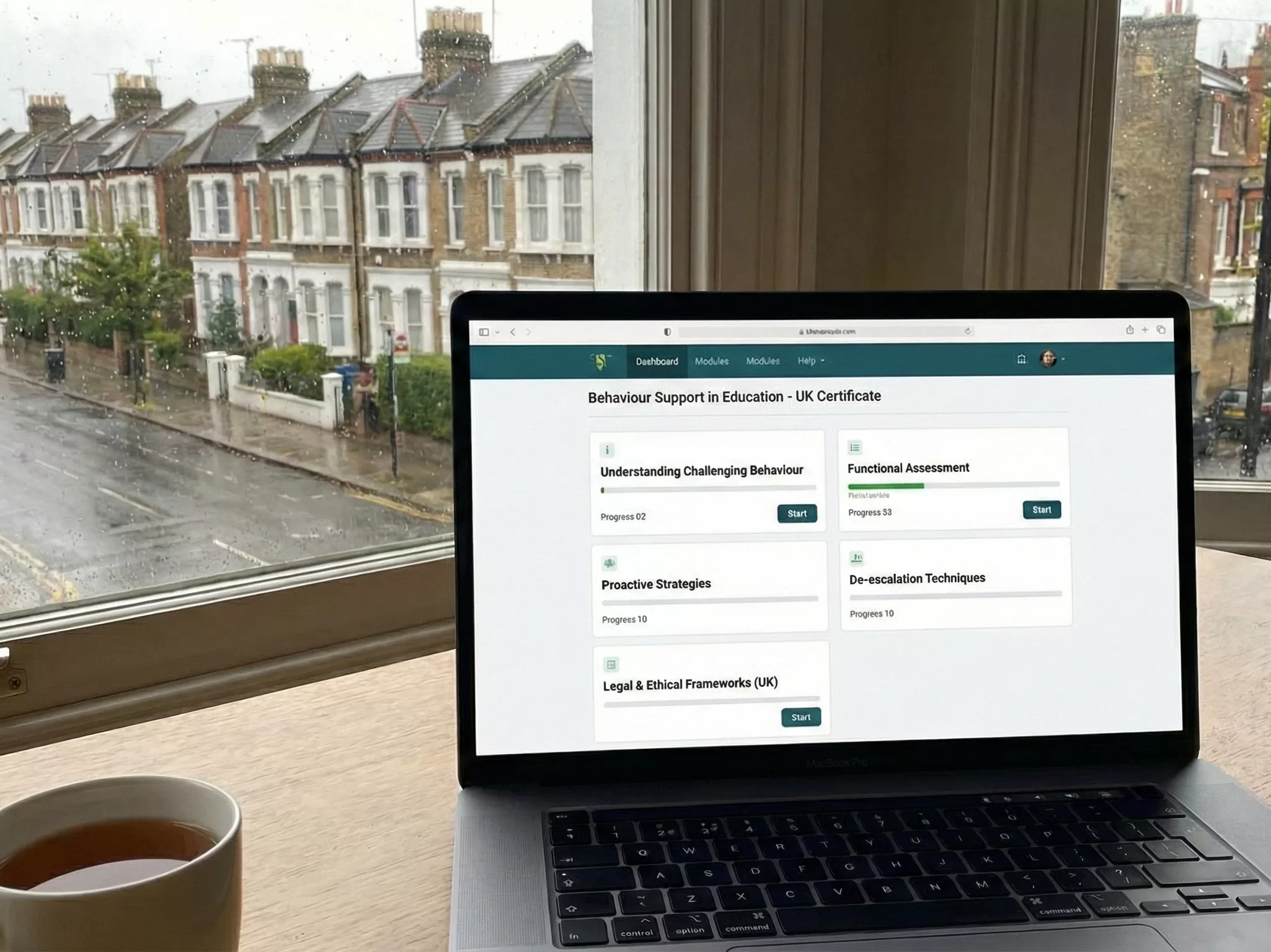
Proof and Credibility Signals
The Level 2 Certificate in Understanding Behaviour that Challenges is regulated by Ofqual and awarded by recognised bodies such as NCFE or TQUK.
It aligns with national SEND frameworks and is recognised within education, childcare and support roles.
National context:
The Department for Education continues to report increased demand for SEND support staff and behavioural specialists across England.
A regulated qualification supports both parental knowledge and professional credibility.
Step by Step: How It Works in Practice
- Check eligibility
Confirm you are aged 19 or over, live in England, and meet income criteria where applicable, usually under £25,750. Use the postcode checker to confirm funding availability. - Apply
Complete the structured application. Documentation verifies eligibility under Adult Skills Fund rules. - Study online
Flexible coursework based learning with tutor support. Assessment is portfolio based. - Receive certification
Gain a Level 2 certificate regulated by Ofqual and awarded by recognised awarding bodies.

Common Misunderstandings
“Behaviour that challenges means bad parenting”
Behaviour is influenced by neurological, emotional and environmental factors. Understanding behaviour that challenges recognises complexity rather than blame.
“It is only relevant for professionals”
Parents benefit directly from structured knowledge, particularly when navigating school systems and SEND processes.
“It labels children”
The qualification focuses on understanding behaviour, not labelling children.
“If behaviour improves, the learning is unnecessary”
Behaviour evolves over time. Structured understanding builds long term awareness and resilience.
Recommended Course
Level 2 Certificate in Understanding Behaviour that Challenges
Disclaimer and Support
Eligibility criteria apply. You must be aged 19 or over, live in England, and meet Adult Skills Fund funding requirements. Funding availability may vary by postcode and local authority allocation.
Found this helpful? There’s so much more to discover. Below, you’ll find more guides and tips designed to support your learning goals and give you even greater clarity as you explore new opportunities.


Learn more and apply today at www.myfreecourse.co.uk
This content is for informational purposes only and does not constitute formal advice. Course availability, funding criteria and eligibility requirements are subject to change. Please visit MyFreeCourse.co.uk or contact us directly for the most up-to-date information.
For extra help or questions, please contact us at [email protected].
MyFreeCourse.co.uk supports you with fully funded qualifications, supportive tutors and flexible learning, so you can start helping others, one step at a time
FAQs
Who is eligible to study understanding behaviour that challenges fully funded?
Eligibility for funded study under the Adult Skills Fund is structured and transparent. To qualify, you must usually be aged 19 or over, live in England, and meet funding criteria that may include income thresholds, employment status, or postcode eligibility depending on local authority allocation.
Funding is not random. The government allocates Adult Skills Fund budgets to accredited colleges to address national skills priorities, including child development, education support and safeguarding knowledge. Colleges can only enrol learners who meet the criteria attached to that funding stream.
This means checking eligibility is not just a formality. It confirms that public funding can legally be applied to your enrolment. Using the postcode checker ensures that funding is currently available in your area and that you meet the requirements before applying.
My Free Course does not set the funding rules. It connects eligible learners with accredited colleges funded to deliver the Level 2 Certificate in Understanding Behaviour that Challenges. Confirming eligibility early helps avoid delays and ensures that public funding is used appropriately.
Is the understanding behaviour that challenges qualification recognised?
Yes. The Level 2 Certificate in Understanding Behaviour that Challenges is regulated by Ofqual, the official qualifications regulator for England. This regulation ensures that the qualification meets nationally defined standards for structure, assessment and quality assurance.
Awarding bodies such as NCFE or TQUK oversee the content and assessment framework. This means the qualification is not informal or attendance based. Learners complete assessed coursework that demonstrates understanding of behavioural theory, safeguarding responsibilities, SEND frameworks and positive behaviour support approaches.
Recognition matters for two reasons. First, it ensures consistency across colleges delivering the qualification. Second, it means employers in education, childcare, social care and support roles understand the level and scope of knowledge involved.
Even for parents who are not seeking employment, studying a regulated qualification provides structured, credible knowledge grounded in national frameworks rather than opinion or online commentary.
How long does it take to complete?
Completion time depends on your pace of study and the time you can realistically commit each week. Most learners complete the Level 2 Certificate in Understanding Behaviour that Challenges within several weeks to a few months.
The qualification is delivered through flexible online coursework, allowing study around family life and existing responsibilities. Assessment is portfolio based rather than exam driven. This means learners complete written assignments or structured activities demonstrating understanding of key concepts such as emotional regulation, environmental triggers, safeguarding links and SEND processes.
Although flexible, the qualification is structured. There are defined learning outcomes and assessment criteria set by the awarding body. This ensures that the certificate represents genuine understanding rather than casual participation.
Engaging consistently with the material helps learners complete efficiently and gain practical insight that can be applied immediately at home or within professional settings.
Will this qualification help if my child has SEND?
The Level 2 Certificate in Understanding Behaviour that Challenges does not replace professional clinical assessment, statutory SEND processes or Education Health and Care Plans. However, it provides structured knowledge that can strengthen how you interpret and respond to behavioural patterns.
The qualification explores areas such as emotional regulation, environmental triggers, neurodevelopmental differences, attachment theory and positive behaviour support. This understanding can improve confidence when speaking with schools, attending SEND meetings or discussing graduated response strategies.
Parents who understand behavioural frameworks are often better equipped to ask informed questions, recognise when additional assessment may be appropriate and collaborate constructively with education professionals.
While the qualification is not a diagnostic tool, it supports deeper awareness of how behaviour connects to underlying needs. That awareness can reduce conflict, increase empathy and support more effective advocacy within existing systems.
Do I need prior qualifications?
The Level 2 Certificate in Understanding Behaviour that Challenges does not usually require prior formal qualifications. It is designed to be accessible to adults returning to study, including parents, carers and those considering work in education or support roles.
However, accessibility does not mean informal. The qualification is assessed and regulated, and learners are expected to engage with written coursework and structured learning materials.
In addition to academic readiness, funding eligibility must be confirmed under Adult Skills Fund rules. This includes age, residency in England, and applicable funding criteria such as income or postcode allocation.
If you are unsure whether you meet the funding requirements, checking eligibility first ensures clarity before beginning the application process. This protects both you and the college delivering the qualification, as public funding can only be applied where criteria are met.
SEO Meta Description
Understanding behaviour that challenges in children. Learn what it means and how a Level 2 qualification supports confident parents in England.